Listen and Download Dr. Helms’ Personalized Audio File Below
Listen and Download The Text-To-Speech File Below
by Eric Helms, Ph.D.
In American social media and media broadly, everyone is talking about the new Dietary Guidelines for Americans. The conversation is not contained to fitness – this politicized back-and-forth is pervasive, with polarized opinions of the new guidelines framing the changes as minor or major, and positive or negative. Herein, we provide our perspective.
Key Points
- The 2025-2030 Dietary Guidelines for Americans (DGAs) utilized a concerning, irregular process. A new, second scientific committee was uniquely appointed to inform their creation: “The Scientific Foundation for the Dietary Guidelines for Americans.” Their guidance was favored over the standard Dietary Guidelines Advisory Committee’s recommendations.
- The new guidance is a mixed bag. The positives are guidance for higher protein and less “highly processed” foods, and the main negative is a redefinition of “healthy fats” to include animal fats and full-fat dairy, while keeping saturated fat limits at 10% of energy, a hard equation to solve without careful planning.
- While most Americans don’t follow the DGAs, they impact the National School Lunch Program, SNAP, WIC, and other federal nutrition initiatives. At worst, some changes may exacerbate health disparities. At best, the new pyramid is confusing, and the message to “eat real food” to reach the dietary targets is costly and logistically challenging in some communities.
- Looking beyond the US at governmental and non-governmental health organizations’ nutrition guidance from their systematic, evidence-based synthesis, the consensus on healthy eating remains stable. The new DGAs are arguably a step further away from the best available evidence.
You have likely seen the online uproar surrounding the release of the 2025-2030 Dietary Guidelines for Americans (DGAs) and its accompanying graphic, an inverted food pyramid. Depending on which talking head you listen to, these changes are either a catastrophic departure from science, a negligible change, a reemergence of suppressed real science, a long-awaited return to ancestral wisdom, or something along this wildly polarized spectrum.
To cut through the noise, we need to understand what DGAs actually are. Historically, they serve two distinct purposes. First, they attempt to provide public-facing guidance: actionable recommendations. To make the guidance more actionable post-release, the government agencies develop heuristics for the layperson (think of the 1992 Food Pyramid or the subsequent, modern MyPlate visual representation and interactive online tools). Second, they function as a policy document. They constrain and influence federal and non-federal programs. Federal programs influenced by the DGAs include the National School Lunch Program, the Supplemental Nutrition Assistance Program (SNAP), which provides food benefits to low-income families, and the Special Supplemental Nutrition Program for Women, Infants, and Children (WIC), among others. Hospitals use the DGAs to set baseline nutrition guidelines for standard and therapeutic diets. DGAs provide the quantitative framework that lawmakers use to build legislation and assess program compliance. While general population guidance that stems from DGAs historically rely on heuristics, examples, interactive tools, and visual aids, the federal guidance must be quantifiable, consistent, and enforceable — historically and presently these two versions of dietary guidance are not always necessarily in perfect alignment.
The US Senate Select Committee on Nutrition and Health Needs commissioned the very first report of dietary goals for Americans in 1977. This report was met with criticism from the industry and scientific community who were concerned that the recommendations were not grounded in relevant science. To counter these concerns, in 1980, the very first DGAs were published by the US Department of Agriculture and Department of Health and Human Services (then called the US Department of Health, Education and Welfare). This document prioritized simplicity, releasing a 10-page pamphlet with seven core rules: eat a variety of foods, maintain ideal weight, avoid too much fat/sugar/sodium, eat adequate starch/fiber, and moderate alcohol. It was primarily a public-facing document. Criticism of the scientific rigor and process used for this report remained widespread. In 1983, a congressional report mandated that a scientific advisory committee of external experts be convened to review the evidence and suggest updates to subsequent reports. The decision was made to update the DGAs every five years, and to ensure DGAs were based on the most up to date scientific evidence based on convening an external panel of independent scientists, establishing the Dietary Guidelines Advisory Committee (DGAC) a process that has been standing for more than 30 years. The previous cycle (2020-2025) DGAs were the successor of this expanding mandate as America grew in population and diversity and as science evolved, with its guidance fully encapsulated in a 164-page report based on an even longer scientific report from the DGAC.
The last DGA cycle’s 164-page report was designed primarily to guide healthcare professionals, with the DGA’s public facing material presented separately (again, think MyPlate). Ironically, the new 2025-2030 guidelines reverted to a simpler, less interactive (at least currently, it may be updated as is often the case with the public facing information that eventually accompanies new DGAs) approach from myplate.gov. The MyPlate website now redirects to realfood.gov, where the first link is to a 1980-style 10-page throwback format PDF, accompanied by an inverted 1992-style food pyramid. The new website begins with the statement that America is sick, and then follows with the claim “For decades we’ve been misled by guidance that prioritized highly processed food, and are now facing rates of unprecedented chronic disease.” Finally, the website sequence concludes with the new DGA’s core message to “eat real food.” While simplicity is generally a virtue, in nutrition policy, the devil is in the details. Furthermore, despite the public facing appearance of simplicity, there is actually more bureaucracy and less transparency behind the scenes of the new DGAs.
What Has (and Hasn’t) Changed?
At a high level, despite the social media firestorm, the direct claim that prior DGA guidance was misleading, and the indirect claim that prior DGA guidance contributed to the current health crisis, the core DGA advice remains boringly consistent with its predecessor. The new guidelines, just like prior iterations, still recommend eating appropriate calories for energy balance, staying hydrated with water, limiting added sugars, and consuming nutrient-dense foods including 5 servings of fruits and vegetables and 3 cups of dairy (or equivalents) per day. Anyone being objective who is informed on the contents of the prior and current DGAs would have to admit that much of the guidance has not changed.
However, while the MASS team is concerned with certain recommendations of the new DGAs, we are more concerned with the process by which the new DGAs were developed. Standard procedure that has persisted for over 30 years involves the well-documented (1) process of convening a DGAC to conduct systematic reviews of all the relevant nutrition evidence, which has a well-established, independent approach, that includes consulting the public in a transparent manner, and adheres to relatively rigid systematic guidelines for evidence-synthesis (2). This committee was formed for the new 2025-2030 cycle in question, just as it was for the 2020-2025 cycle, and all preceding DGA cycles after the very first.
Previously, small but growing sectors of the fitness, wellness, and alternative health communities mischaracterized the process of creating the DGAs as secretive, heavily influenced or outright bought and paid for by lobbyists, “Big Food,” or other nefarious actors — which couldn’t be further from the truth. In actuality, the DGAC consists of an independent volunteer panel of leading national nutrition experts, vetted for financial and personal conflicts of interest, who develop all of their guidance based on systematic literature reviews, and meet in forums open to the public, which are livestreamed and recorded (3). For the 2025-2030 guidelines, the DGAC produced a whopping 421-page publically available report detailing their evidence collection, summary, and synthesis, and ultimately the specific nutrition guidance they recommended be used in the DGAs.
Historically, the DGAs have broadly reflected DGAC guidance in past cycles, but the federal government has never completely or perfectly adopted it without any changes. However, the current administration uniquely deviated, or more accurately, added to this process (but ultimately subverted it). They contracted a second committee they named “The Scientific Foundation for the Dietary Guidelines for Americans.” This second committee produced a competing 90-page report that claims to also have used an evidence-based, systematic process, yet it arrived at different conclusions on key issues like protein and dairy fats (among others). Ultimately, the federal agencies chose to favor this second committee’s report over the first, and publicly dismissed the DGAC’s guidance as biased. The 90-page report by “The Scientific Foundation for the Dietary Guidelines for Americans” begins with a preamble about this supposed bias, why the DGAC guidance was not followed, and the degree to which various aspects of the DGAC’s guidance were partially or fully accepted or rejected. Thus, despite a veneer of simplicity, there was actually more bureaucracy in the creation of the new DGAs behind the scenes, due to the creation of a second committee.
Furthermore, arguably, this second committee had less oversight and transparency than the DGAC. For interested readers, we direct you to an online news article. This article was written by Professor Cristina Palacios, a member of the DGAC, and if you don’t want to read the full article, this is the most relevant quote where she states this second committee report was “created by a group of people who were not vetted in the usual way, and although they repeated some of the same questions we did, they also explored other topics that were chosen with no input from the wider community of nutrition researchers or from the public. It was not based on a publicly available protocol, with no input from the scientific community, and it’s unclear how and to what degree it was peer-reviewed. The updated dietary guidelines were developed through a different process compared with the established methodology that’s been used to assess nutrition science behind the guidelines for many years.” Professor Christopher Gardner, who also served on the DGAC, posted his reaction to the second committee disregarding DGAC guidance in his Instagram reel, outlining similar sentiments.
This process resulted in some recommendations which aligned more and some less with the best available evidence and global scientific consensus compared to the last DGA cycle guidance. Specifically, there are four changes beyond the “How” to the “What” which are worth discussing:
New Protein Guidance
The new guidelines recommend 1.2–1.6g of protein per kilogram of body weight per day. This is a substantial jump from the previous guidelines. The previous guidelines (see page 138) provided daily protein targets, to meet the RDA based upon sex, body mass, and total caloric needs. Importantly, the new recommendations in the DGAs do not represent a shift in the RDA; rather, the new guidelines appear to no longer be using the RDA to direct its recommendation. It’s crucial not to conflate the RDA and recommendations of the DGAs, they are different and set by different entities. The RDA is set by theNational Academy of Sciences and represents the adequate average intake to “meet the nutrient requirements of nearly all (97-98%) of healthy people.” Historically, if a change in protein recommendations is made, the RDA would be shifted first, then the DGAs would adjust its recommendations to fit the RDA.
Despite circumventing this process, academically, we view this as a positive shift. As we’ve covered many times in MASS, higher protein intakes at the population level could mitigate sarcopenia and osteopenia, aid in satiety, and potentially improve body composition by marginally increasing lean mass and reducing fat mass, and have subsequent positive downstream effects on metabolic disease and maybe even all cause mortality. However, protein is not consumed in a vacuum, and source matters. In the real world when people eat more protein, they invariably eat less of something else, which I’ll discuss the implications of shortly.
The Redefinition of “Healthy Fats”
The new DGAs define “healthy fats” to also include those found in meat, poultry, eggs, and full-fat dairy, while explicitly recommending butter and beef tallow for cooking. This is a pivot from previous iterations that emphasized unsaturated sources. In a vacuum, choosing full-fat dairy or eating red meat, or cooking with butter is not inherently unhealthy in the context of an overall balanced diet that doesn’t contain excessive saturated fat. As we’ve also covered in MASS, the data on saturated fat and health are nuanced with regards to the effect of specific types of saturated fat on specific subfractions of cholesterol, and their subsequent impact on cardiovascular disease risk. However, the collective data indicate keeping total saturated fat intake <10% of total calories is optimal for cardiovascular disease risk (which was reflected in previous DGAs). Given the new DGAs’ redefinition of healthy fats to include saturated animal-based fat sources and their recommendation to cook with beef tallow and butter, you might be surprised (we were) that the new guidelines maintain the recommendation to keep saturated fat <10% of total daily calories.
While in line with the evidence, this creates an internal conflict. If you follow the guidance to prioritize eggs, red meat, and full-fat dairy, and cook with tallow or butter, sticking to a 10% limit becomes a mathematical tightrope act that the average consumer is unlikely to navigate successfully. Furthermore, the guidelines advise against cooking with seed or nut oils due to mechanistic concerns about oxidation and inflammation, a stance that (as we’ve also discussed) conflicts with most relevant and ecologically valid human research showing broad neutral to positive health outcomes at the population level for these fats.
Guidance Against Eating “Highly Processed” Food
In general, we at MASS agree that consuming less highly processed food and more whole food is a good thing. However, this is not really a new emphasis of the DGAs, as they’ve always emphasised fruits, vegetables, and less processed whole foods. But there are more concerns from a public health perspective, due to the specific recommendation to avoid “highly processed” foods. Notably, the guidelines eschew the still scientifically emerging definition of “ultra-processed foods” (UPF) in favor of this new, even less defined term. As we’ve previously discussed, the UPF classifications are an established (yet debated) set of criteria, based on what food industry processes were used in creating a given food, rather than its impact on health (4). Thus, it’s understandable that the health-focused guidelines of the DGAs use the “highly processed” terminology instead without the same specific definition; while understandable, this creates a problem.

Nutritional Competence
This ambiguous terminology used in the second committees’ report, as well as the new DGAs, groups all “processed” foods together without a clear definition. This grouping risks conflating nutrient-poor processed food (like pastries) with nutrient-dense processed health staples (like whey protein, canned beans, or low or non-fat, high-protein dairy products or fortified dairy alternatives). Furthermore, because “highly processed” has no legal or scientific definition, it is functionally unenforceable in policy. School districts, which often rely on cost-effective, healthy processed options like whole grain breads or low-fat yogurt (which the new guidance would switch to full-fat, but would not allow if it contained added sugar until they were ≥10 years old) may be left without clear guidance. This ultimately could hurt those relying on federal food programs the most.
Alcohol Guidance
This is the most curious change in terms of messaging. Historically, DGAs have recommended limiting alcohol intake to no more than one standard drink per day for females or two drinks per day for males. The new guidelines vaguely encourage Americans to limit alcohol intake, with no specific guidance regarding the number of daily drinks. At first glance, this is actually an evidence-based improvement upon the old guidelines. As we’ve discussed in MASS, previous research had suggested that light alcohol consumption could, in some contexts, be even healthier than complete abstinence. But as new evidence has become available, the updated scientific consensus is that the “healthiest” amount of alcohol intake is none, with nonlinear health risks observed as alcohol intake increases. In short, no alcohol is great, light alcohol intake is fine, and heavy alcohol intake is pretty disastrous. However, when Dr. Oz recently elaborated on these guidelines, his messaging led to considerable confusion. In a span of roughly 60 seconds, he presented a mixed bag of conflicting statements – some alluded to the updated perspective that lower alcohol intake is better (presumably down to an intake of zero), while some seemed to downplay the health ramifications of alcohol consumption by acknowledging the alcohol intake observed in some “Blue Zones.” After these clips entered the social media aggregation cycle, I had several people ask me why the guidelines were now “more permissive” of alcohol intake, which probably wasn’t the intended effect. So the real interpretation of this guideline change is complicated: better as written, but worse as communicated.
The Overall Messaging
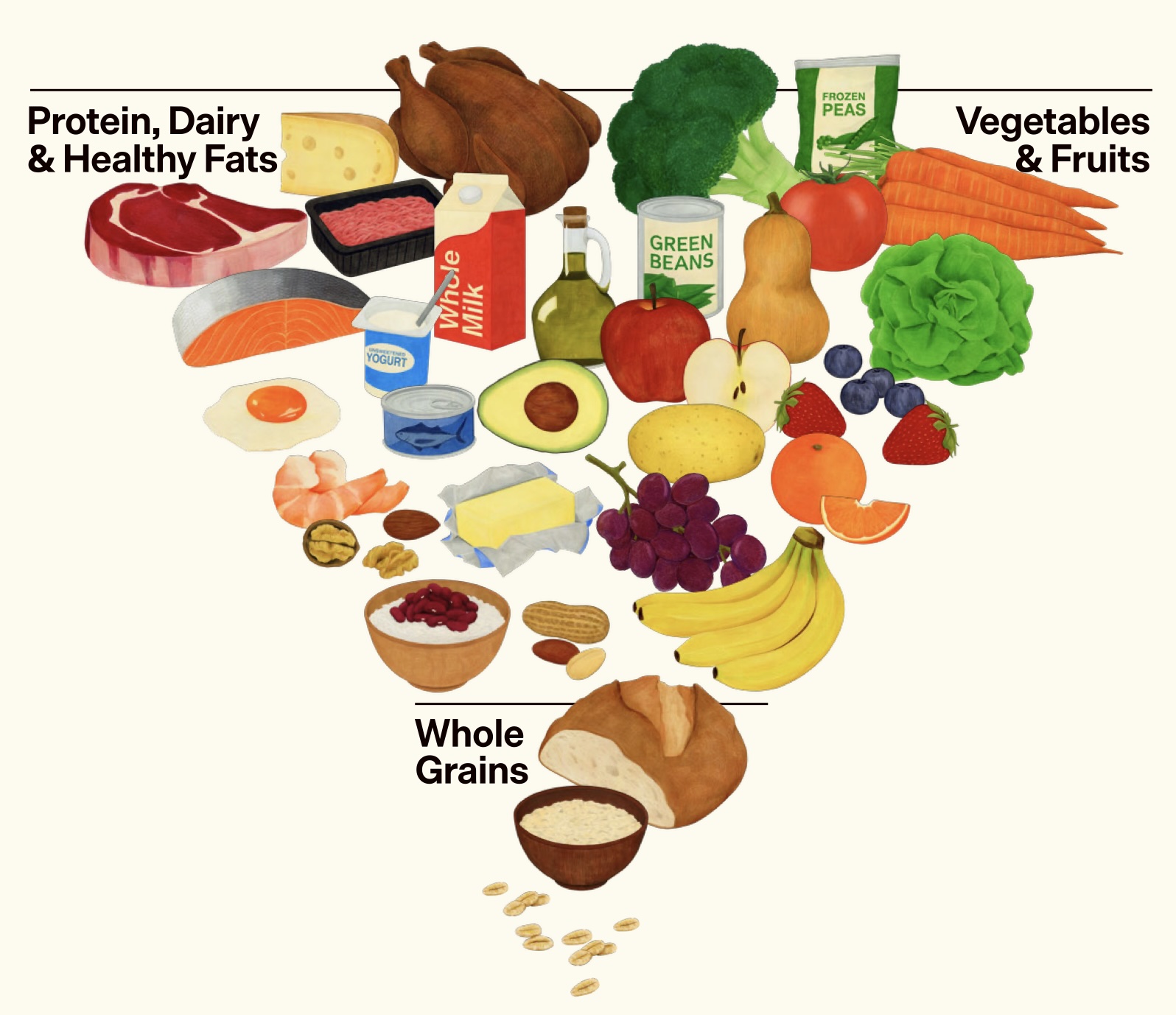
The confusion culminates in the overarching messaging and its visual representation. The new “inverted pyramid” graphic (Figure 2) presents an abstract hierarchy that arguably conflicts with the text it accompanies. It places a large emphasis on red meat, cheese, and whole poultry at the “top” (widest section), while relegating whole grains (and not even explicitly refined or processed grains) to the smallest point at the bottom.

This visual hierarchy seemingly demotes grains far below what the written guidelines actually recommend (which still advise consuming whole grains, which in terms of “servings” are still the highest proportionally recommended food group despite what the pyramid shows), creating a visual disconnect from the written guidance that is, in our opinion, less actionable and more confusing for the average consumer than previous tools like MyPlate, which offered proportional guidance for a single meal.
Furthermore, the message to “eat real food” sounds sensible but is arguably tone-deaf to certain communities in the current economy. The visual emphasis on large cuts of meat and blocks of cheese promotes expensive items, while the visual minimization of grains discourages cheaper staples. “Real” food, defined as fresh meat, produce, and minimally processed dairy by the new DGAs, is expensive and often less accessible in “food deserts” (areas with limited access to affordable and nutritious food), while processed foods are often the most affordable and shelf-stable options for families with lower socioeconomic status (5, 6).
By combining high-protein recommendations with a push for more expensive “healthy” fats and a general rejection of cheaper processed staples, without nuanced guidance as to which processed foods are better or worse for health, the average American will likely spend more money if they’re trying to follow the new DGAs. Furthermore, government programs through the USDA and other agencies are massive purchasers in the food industry. Thus, since government buyers will base their decisions on the DGAs, this may increase the cost of government nutrition benefit programs.
Do Americans Even Follow Guidelines?
A common narrative in paleo, low-carb, carnivore, and general anti-establishment, alternative health nutrition circles, is that the obesity epidemic was caused by the “bad” or corrupt dietary guidelines of the past (be they incompetently developed or conspiratorily masterminded – with some people paradoxically claiming both simultaneously). As previously discussed, this is not an accurate representation of the well-documented, transparent, and evidence-based process of developing prior DGAs. Further, despite the new DGAs being broadly similar to prior guidance, this narrative has been ironically adopted on the realfood.gov website. However, a potent push-back in the evidence-based nutrition community against this narrative, is that this is factually incorrect for one simple reason: Americans don’t follow the guidelines. Data consistently show that the vast majority of Americans do not meet federal dietary recommendations (7), so the claim that the recommendations are the cause of ill health can’t be true.
Unfortunately, this narrative is also a bit flawed, and perhaps focuses too much on the individual, and not enough on American society. While Americans don’t follow the DGAs when surveyed, this doesn’t mean they don’t matter (but it also doesn’t mean they are the cause of population wide chronic illness). While they may not dictate what you put in your shopping cart, they dictate what goes onto a school lunch tray or into a WIC package. Replacing low-fat options with whole milk in schools might seem “natural,” but for children already consuming hyper-palatable, energy-dense diets due to economic constraints, adding more energy-dense liquid calories is likely a public health error. Thus, these guidelines shape the food environment for the most vulnerable populations, even if they are largely ignored by the general public.
The MASS Position
If you are confused by the whiplash of the 2025-2030 US DGA update, or skeptical about which set of guidelines are truly “evidence-based,” it is helpful to zoom out and look beyond US borders. We at MASS encourage you to examine guidelines developed by other expert groups, both governmental and non-governmental, which use rigorous processes of evidence synthesis. Not necessarily to pick your “favorite” or as an appeal to authority, but to zoom out and synthesize their recommendations to get a broader assessment of the global expert consensus.
UK Eatwell Guide
The UK’s Eatwell Guide provides advice on healthy eating that largely mirrors prior DGA guidance:
- Eat at least five portions of a variety of fruit and vegetables every day.
- Base meals on potatoes, bread, rice, pasta, and other starchy carbohydrates, choosing whole-grain versions where possible.
- Include some dairy or dairy alternatives (such as soy drinks), opting for lower-fat and lower-sugar options.
- Eat some beans, lentils, peas, fish, eggs, meat, and other proteins (including two portions of fish every week, one of which should be oily).
- Choose unsaturated oils and spreads, and consume them in small amounts.
- Drink 6 to 8 cups/glasses of fluid a day.
- If consuming foods and drinks high in fat, salt, or sugar, have these less often and in small amounts.
Despite being developed independently by different expert groups, both the 2020-2025 DGAs and 2016 UK Eatwell guidelines (which while good overall, are due for an update [8]) arrive at nearly identical conclusions. This consistency reflects both being grounded in systematic, evidence-based review processes (9).
World Health Organization Guidance on Healthy Eating
Another example of evidence-based guidelines comes from the 2020 Healthy Diet Indicator criteria, developed by a team of nutrition researchers who collated and updated dietary recommendations from the World Health Organization (WHO) (10). Despite not being tied to any single government, these guidelines broadly align with the 2020-2025 DGAs and UK recommendations with a slightly different, more quantitative approach. Their recommendations are numerically specific where data support it, but when a dose-response relationship hasn’t been clearly established, the advice is more general, like the UK guidance.
Dr. Trexler previously went into depth as to how these guidelines operate and evolved with the evidence, noting that for foods with health-promoting effects, but without an established dose-response relationship, the recommendation is simply to consume more than 0 g per day. Likewise, for foods with established negative health effects, such as processed meat, the guidance is to consume 0 g per day, not because small amounts are harmful, but because no safe threshold is firmly identified in the research.
To conclude, while minor differences exist largely in implementation, if you compare these independent, international standards with the 2020-2025 US Dietary Guidelines, they largely converge. All three (the UK Eatwell Guide, the WHO criteria, and the previous US guidelines) arrive at nearly identical conclusions to eat:
- A foundation of fruits, vegetables, and starchy carbohydrates (preferably whole grain).
- Moderate amounts of dairy and protein (emphasizing beans, pulses, fish, and eggs).
- Limited amounts of saturated fat, salt, and sugar.
This convergence exists because that is what the totality of the evidence supported at the time of their creation (and still supports, in broad strokes). These guidelines were developed independently by different expert groups, yet they point in the same direction. Since the 2016 UK guidance and 2020 WHO guidance were created, however, the data has progressed, making it even more unfortunate that the 2025 DGAC guidance was not followed for the current DGA cycle. Thus, if the 2025-2030 US Guidelines had used the existing, arguably more objective, transparent and evidence-based process that was used in previous DGA cycles, perhaps the aforementioned steps away from the evidence consensus, such as promoting saturated animal fats, would not have occurred.
Conclusion
Overall, the new DGAs actually have not changed that much, with several notable exceptions which are a mixed bag. We generally support higher protein recommendations than the RDA (which contrary to historical precedent, was not changed prior to the DGA recommendation) for healthy individuals, and the general advice to reduce consumption of processed foods, when shown to be unhealthy. However, the fat guidance is confusing at best and contradictory at worst. Maintaining a 10% of calories from saturated fat limit is mathematically difficult alongside the recommended fat sources and the reality that recommending higher protein invariably increases fat intake in the general public. More importantly than the “what,” changes to the “how” concern us. The necessity for including a second scientific advisory committee is unclear, especially a second committee that was not vetted to the same degree as the DGAC, nor required to follow as transparent a process. Additionally, the public facing messaging creates problems. The new food pyramid visually conflicts with the written text. The guidance to “eat real food,” while simple and broadly scientifically sound, is logistically and financially difficult to implement without an economic shift where produce and whole food protein sources become more accessible and affordable to lower income communities. Further, ambiguity related to what constitutes “highly processed foods,” promoting the naturalistic fallacy, and conflating processing to mean “less healthy” in all cases, may inadvertently move people away from affordable, accessible, healthy, yet processed options. Off-hand comments about alcohol consumption in “Blue Zones” distracts from the actual recommendation to limit alcohol intake. Finally, new guidance is less clear and supportive for those with specific dietary needs (such as religious, cultural, or ethical vegetarians and vegans, or those with lactose intolerance, or more tailored guidance for different life stages, or guidance related to breastfeeding/formula feeding). Collectively, these issues leave some of the most vulnerable people less informed. Thus, we recommend following the broad scientific consensus on healthy eating, which are arguably better represented in the UK, WHO, and 2020-2025 DGA guidance.
References
- National Academies of Sciences, Engineering, and Medicine; Health and Medicine Division; Food and Nutrition Board; Committee to Review the Process to Update the Dietary Guidelines for Americans. Optimizing the Process for Establishing the Dietary Guidelines for Americans: The Selection Process. Washington (DC): National Academies Press (US); 2017 Nov 16. 2, The Dietary Guidelines Advisory Committee Process.
- Snetselaar LG, de Jesus JM, DeSilva DM, Stoody EE. Dietary Guidelines for Americans, 2020-2025: Understanding the Scientific Process, Guidelines, and Key Recommendations. Nutr Today. 2021;56(6):287-295.
- de Jesus JM, Stoody EE, DeSilva DM, et al. Addressing misinformation about the Dietary Guidelines for Americans. Am J Clin Nutr. 2024;119(5):1101-1110.
- Monteiro CA, Cannon G, Moubarac JC, Levy RB, Louzada MLC, Jaime PC. The UN Decade of Nutrition, the NOVA food classification and the trouble with ultra-processing. Public Health Nutr. 2018;21(1):5-17.
- Pineda E, Stockton J, Scholes S, Lassale C, Mindell JS. Food environment and obesity: a systematic review and meta-analysis. BMJ Nutr Prev Health. 2024;7(1):204-211.
- Leydon CL, Leonard UM, McCarthy SN, Harrington JM. Aligning Environmental Sustainability, Health Outcomes, and Affordability in Diet Quality: A Systematic Review. Adv Nutr. 2023;14(6):1270-1296.
- Krebs-Smith SM, Guenther PM, Subar AF, Kirkpatrick SI, Dodd KW. Americans do not meet federal dietary recommendations. J Nutr. 2010;140(10):1832-1838.
- Rayner M. Is the Eatwell Guide still appropriate for the UK? Proc Nutr Soc. Published online September 9, 2025.
- Cullum A. Developing food-based dietary recommendations in the UK. Proc Nutr Soc. 2024;83(1):55-61.
- Herforth AW, Wiesmann D, Martínez-Steele E, Andrade G, Monteiro CA. Introducing a Suite of Low-Burden Diet Quality Indicators That Reflect Healthy Diet Patterns at Population Level. Curr Dev Nutr. 2020;4(12):nzaa168.