by Eric Helms, Ph.D.
Study Reviewed: Exercise Selection Differentially Influences Lower Body Regional Muscle Development. Burke et al. (2024)
Key Points
- Variety isn’t a new concept. The Weider “Muscle Confusion Principle” promoted high training variation and exercise variety for hypertrophy decades ago.
- In this study, variety was conditionally beneficial, as leg extensions grew the rectus femoris more, while leg presses grew the vastus lateralis more. However, straight leg calf raises produced better or similar growth than bent leg calf raises in all calf muscles.
- Thus, rather than a “good or bad” view of exercise variety, you should know why variety is important, as this knowledge informs effective bodybuilding exercise selection.
For decades, bodybuilders have preached that “switching it up” is needed for continued growth, often taking the form of high exercise variety. While there is truth in this belief, it can lead to inefficient training if you don’t know why and how to apply it.
Data showing the existence of regional hypertrophy is not the same as data showing bodybuilders can reliably and intentionally manipulate it as desired. For example, preacher curls are claimed to increase one’s bicep peak, which in my mind means preferential growth of the proximal biceps (near the shoulder), but they actually produce greater distal hypertrophy near the elbow. The only widely held belief I’m aware of, is the general view that exercise variety is “good” for ensuring development of all muscles, muscle regions, and for continued growth.
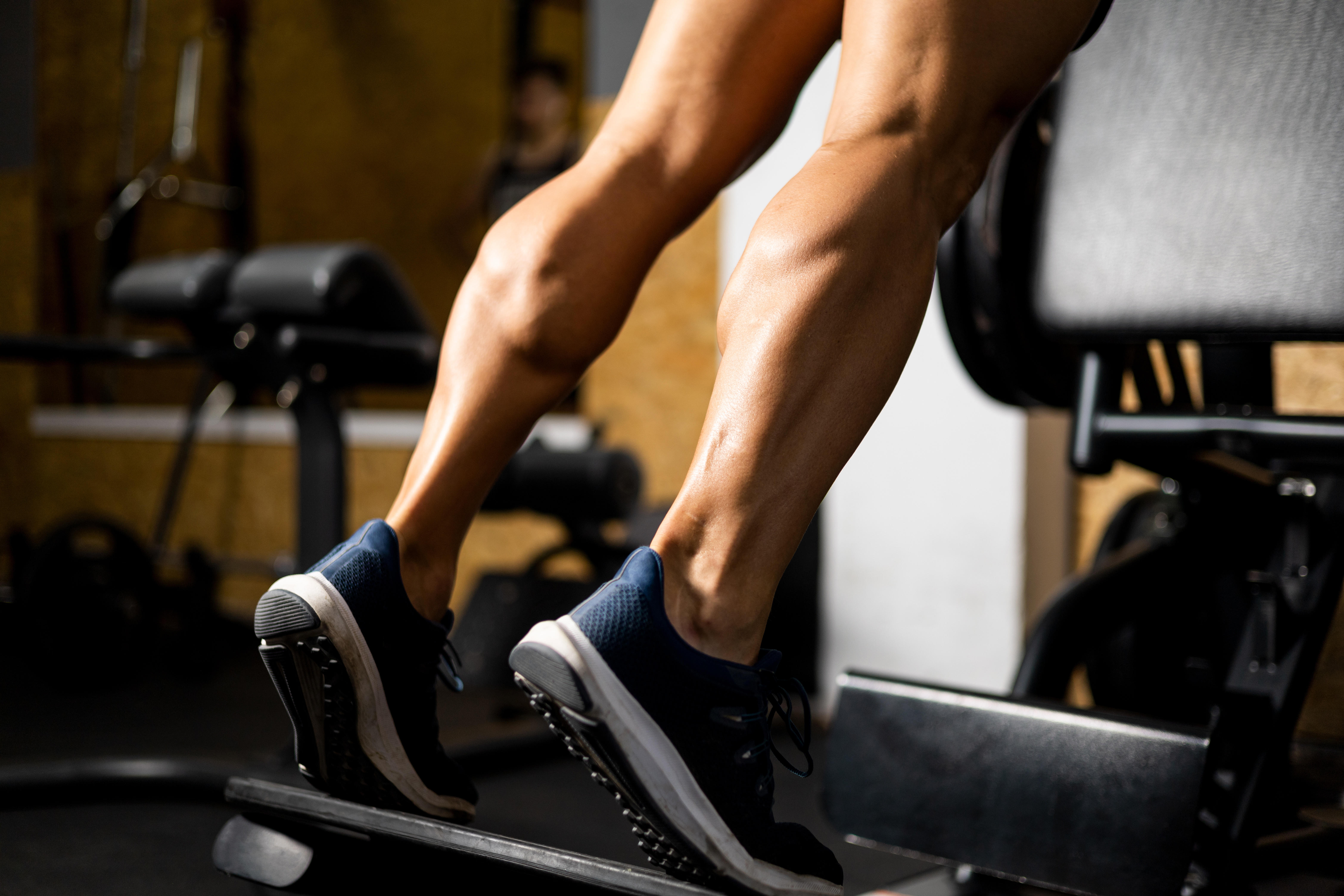
In a new study, authors aimed to determine if regional hypertrophy in the quadriceps and calves would differ due to exercise selection. They conducted an 8-week within-participant study in which each participant trained twice per week. One leg was randomly assigned to either leg press or leg extension and also randomly assigned to either calf raise on the leg press or seated calf raise, with the opposite exercises assigned their opposite leg. At the start and end of the training period, muscle thickness of the rectus femoris, vastus lateralis, soleus, medial gastrocnemius, and lateral gastrocnemius were measured via ultrasound.
Findings
As shown in Table 1, average muscle thickness increases of the whole rectus femoris (5.3mm versus 2.8mm) as well as increases at the 30 (2mm versus 1.2mm), 50 (2.2mm versus 1.5mm), and 70% (1.1mm versus 0.1mm) measurement sites were greater following leg extensions compared to leg press. However, the opposite was true for the vastus lateralis, as whole (4.8mm versus 1.7mm), 30 (1.8mm versus 0.5mm), 50 (1.9mm versus 0.9mm), and 70% (1.3mm versus 0.7mm) measurement sites increased more following leg press than leg extension. As shown in Figure 1, you’d likely experience a small sized greater effect from choosing the leg press for vastus lateralis growth (posterior probabilities ranging from 0.875 to 0.994, depending on measurement site), and for choosing the leg extension for rectus femoris growth (posterior probabilities ranging from 0.910 to 0.990). The logical inference from these regional hypertrophy differences between exercises, is that the combination of a multi-joint and a single-joint quadriceps exercise would produce better net quadriceps hypertrophy than either in isolation, making a case for the importance of variety.


However, the case for variety is weaker when viewing the calf results. Average muscle thickness increases of the medial gastrocnemius were more than three-fold greater following straight leg calf raises compared to bent leg (1.3mm versus 0.4mm) and were similar-ish for the lateral gastrocnemius (1.2mm versus 0.9mm), slightly favoring straight leg calf raises, and soleus (0.5mm versus 0.7mm), but slightly favoring bent leg calf raises. Probabilistically, we’d predict you’d experience a small sized greater effect from choosing the straight versus bent leg calf raises (posterior probability of 0.991) for medial gastrocnemius growth and a trivial to small sized greater effect for lateral gastrocnemius growth (posterior probability of 0.904). Weaker evidence (posterior probability of 0.716) indicated you’d likely experience a trivial sized greater effect from choosing the bent versus straight leg calf raise for the soleus.
Notably, since some plantarflexion occurs in a leg press but not a leg extension, the authors controlled for this potential confounding effect by also doing an analysis in only the legs assigned to leg extensions. This necessarily was a lower sample size analysis, so it is more uncertain. With that said, it produced different results. Specifically, while the medial gastrocnemius findings remained consistent, still favoring better hypertrophy following straight leg calf raises (posterior probability of 0.925), the lateral gastrocnemius findings reversed (posterior probability of 0.274), and the soleus findings strengthened (to a posterior probability of 0.859). Therefore, in aggregate, I’d interpret the calf findings from this study as follows: straight leg calf raises produced better hypertrophy for the medial gastrocnemius, didn’t produce meaningfully different hypertrophy than bent leg calf raises for the lateral gastrocnemius, and soleus growth was minimal following both, but leaned slightly in favor of bent leg calf raises. Now, if this was the only study to compare bent versus straight leg calf raises, you could still make a semi-compelling case for variety being better, and that you should at least do some seated calf raises every now and then to ensure a maximal soleus stimulus. However, this is not the only study. As I previously reviewed, Kinoshita and colleagues measured hypertrophy of the calves in a within-participant design, with each participant performing seated calf raises with one leg and standing calf raises with the other (6). While both legs experienced similar soleus growth, there was substantially greater growth in the lateral and medial gastrocnemius in the legs performing standing calf raises. Therefore, considering the totality of data, I’d argue time spent performing seated calf raises would be better spent performing straight leg calf raises, making a case against variety specifically for calf training.
Thus, like most things in life, a broad, black or white view on the topic of variety is incomplete, so we must dig deeper. As we’ve discussed, muscles that cross and act on two joints (called biarticular muscles), like the rectus femoris which performs knee extension and hip flexion, often benefit from isolation. Because the leg press consists of knee extension and hip extension, the hip flexion action of the rectus femoris is in direct opposition to hip extension occurring during leg press. Therefore, as shown in the present study, the rectus femoris is not well-recruited or stimulated during multi-joint hip and knee extension exercise. Demonstrating this further, a lack of hypertrophy is observed in the rectus femoris – as well as the biarticular hamstrings (which perform hip extension and knee flexion) – following back squat training (7). In further evidence of this point, the biarticular long head of the triceps grows more from single-joint triceps exercise than from bench press (8). To conclude, muscles that cross multiple joints will often require isolation for maximal development, leading to a necessity for higher exercise variety.
However, for the calves, despite the soleus being a monoarticular muscle only crossing the ankle joint, bodybuilders have long suggested that standing calf raises won’t effectively train the soleus and that you need to do seated calf raises. Their argument is that by bending the knee, you shorten the gastrocnemius, creating active insufficiency such that it can’t contribute to the exercise, ensuring greater soleus contribution. However, as I stated in my last article on calf training, “There’s no reason to think that the gastrocnemius needs to be taken out of the equation or that the soleus needs to be ‘isolated’ to be effectively trained. Further, I can’t think of any other monoarticular muscle where we hold this belief. For example, no one argues that hamstring curls are ineffective for the short head of the biceps femoris (a monoarticular muscle) because the rest of the hamstrings also contribute to knee flexion.” In summary, while biarticular muscles often require isolation exercises to maximize growth, monoarticular muscles simply require an exercise that trains the action they perform. For example, the short head of the biceps femoris only performs knee flexion, so it’s unsurprising that it produces more surface electrical activity during leg curls than during stiff leg deadlifts (9), which only consist of hip extension. Thus, it’s important to move past a simplistic understanding of exercise selection and exercise variety for bodybuilding. Stay away from camps that either believe a minimalistic, compound-dominant approach, or an isolation-based approach is categorically better.
Application and Takeaways
Bodybuilding coaches need a modicum of functional anatomical knowledge to be effective, as exercise variety is more important for bodybuilding than other lifting disciplines. But, in each case this is true, there is a reason. With basic anatomical knowledge you learn that the biceps, calves, lats, and middle deltoids aren’t stimulated by the squat, bench, deadlift, snatch, clean and jerk, or overhead press, because these muscles just aren’t involved, or aren’t involved much in these lifts. With slightly deeper anatomical knowledge you learn some heads of muscles that are involved in these lifts, don’t actually contribute to them, because they don’t share all of the actions of the muscle group they’re part of, like the biceps femoris short head not contributing to deadlifts as it performs knee flexion but not hip extension. With even deeper anatomical knowledge you learn that some muscles that could contribute to one joint action in a lift, don’t contribute to that lift because one of the other joint actions in that lift opposes another action the muscle performs. This is true of the long head of the triceps in pressing, because it also performs shoulder extension, and of the hamstrings and rectus femoris in squatting, because they also perform knee and hip flexion, respectively.
References
- Burke R, Piñero A, Mohan AE, Hermann T, Sapuppo M, Augustin F, Coleman M, Korakakis PA, Wolf M, Swinton PA, Schoenfeld BJ. Exercise Selection Differentially Influences Lower Body Regional Muscle Development. Journal of Science in Sport and Exercise. 2024 Jul 12:1-1.
- Antonio J. Nonuniform response of skeletal muscle to heavy resistance training: Can bodybuilders induce regional muscle hypertrophy? J Strength Cond Res. 2000 Feb 1;14(1):102-13.
- Zabaleta-Korta A, Fernández-Peña E, Torres-Unda J, Francés M, Zubillaga A, Santos-Concejero J. Regional Hypertrophy: The Effect of Exercises at Long and Short Muscle Lengths in Recreationally Trained Women. J Hum Kinet. 2023 Jul 15;87:259-270.
- Refalo MC, Helms ER, Robinson ZP, Hamilton DL, Fyfe JJ. Similar muscle hypertrophy following eight weeks of resistance training to momentary muscular failure or with repetitions-in-reserve in resistance-trained individuals. J Sports Sci. 2024 Jan;42(1):85-101.
- Zabaleta-Korta A, Fernández-Peña E, Torres-Unda J, Garbisu-Hualde A, Santos-Concejero J. The role of exercise selection in regional Muscle Hypertrophy: A randomized controlled trial. J Sports Sci. 2021 Oct;39(20):2298-2304.
- Kinoshita M, Maeo S, Kobayashi Y, Eihara Y, Ono M, Sato M, Sugiyama T, Kanehisa H, Isaka T. Triceps surae muscle hypertrophy is greater after standing versus seated calf-raise training. Front Physiol. 2023 Dec 13;14:1272106.
- Kubo K, Ikebukuro T, Yata H. Effects of squat training with different depths on lower limb muscle volumes. Eur J Appl Physiol. 2019 Sep;119(9):1933-1942.
- Brandão L, de Salles Painelli V, Lasevicius T, Silva-Batista C, Brendon H, Schoenfeld BJ, Aihara AY, Cardoso FN, de Almeida Peres B, Teixeira EL. Varying the Order of Combinations of Single- and Multi-Joint Exercises Differentially Affects Resistance Training Adaptations. J Strength Cond Res. 2020 May;34(5):1254-1263.
- Schoenfeld BJ, Contreras B, Tiryaki-Sonmez G, Wilson JM, Kolber MJ, Peterson MD. Regional differences in muscle activation during hamstrings exercise. J Strength Cond Res. 2015 Jan;29(1):159-64.